 Image 1 of 1
Tension Between Order and Chaos
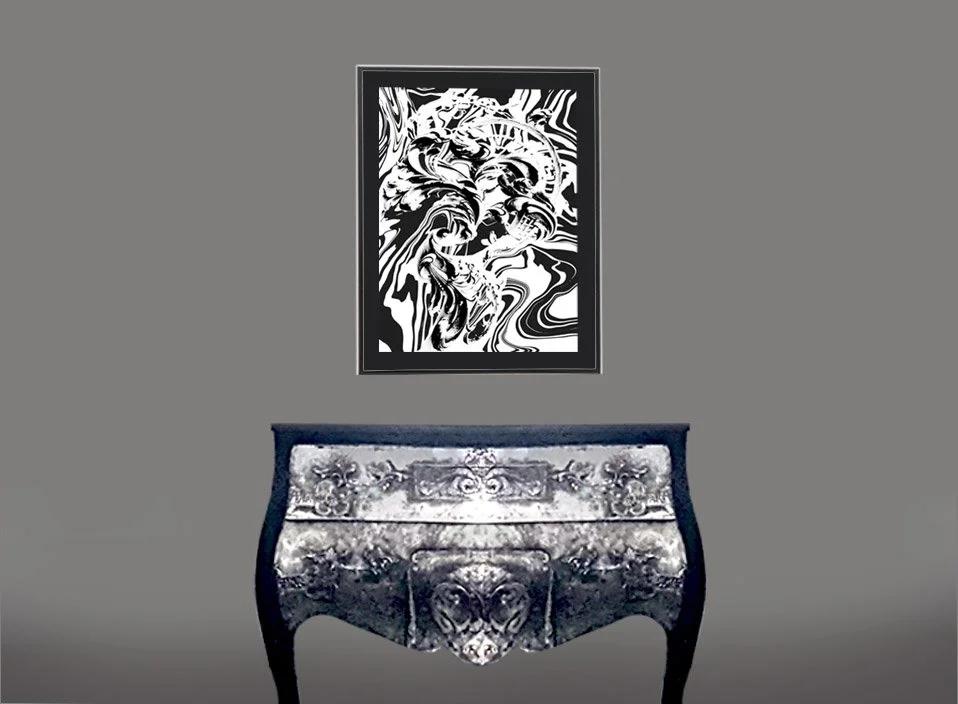
The image creates a compelling visual "tug-of-war." By taking a classical Baroque motif (the acanthus leaf) and subjecting it to a modern "liquify" distortion, A sense of "digital decay." The viewer’s eye constantly switches between trying to recognize the solid, historical architectural form and surrendering to the fluid, psychedelic movement of the background. This tension keeps the composition from feeling static and makes it feel "alive."
Use of Negative Space and Contrast
The refusal to use gray tones—sticking strictly to stark black and white—gives the piece incredible graphic "punch." The way the white "splashes" or "vines" break out of the central mass and bleed into the warped background creates a high-energy flow. This "hard-edge" approach ensures that even the most complex, busy areas of the design remain legible and impactful from a distance, which is likely why this style is so effective
Tension Between Order and Chaos
The image creates a compelling visual "tug-of-war." By taking a classical Baroque motif (the acanthus leaf) and subjecting it to a modern "liquify" distortion, A sense of "digital decay." The viewer’s eye constantly switches between trying to recognize the solid, historical architectural form and surrendering to the fluid, psychedelic movement of the background. This tension keeps the composition from feeling static and makes it feel "alive."
Use of Negative Space and Contrast
The refusal to use gray tones—sticking strictly to stark black and white—gives the piece incredible graphic "punch." The way the white "splashes" or "vines" break out of the central mass and bleed into the warped background creates a high-energy flow. This "hard-edge" approach ensures that even the most complex, busy areas of the design remain legible and impactful from a distance, which is likely why this style is so effective